Getting to church in the States is not a big deal. You leave your house, hop in your car, and appear minutes later at the door of your church, ready to walk in and worship. It's not quite the same for me here in Peru...Maybe you should just come along with me and you'll see what I mean. Ready? Let's go!
It's a beautiful Saturday afternoon and I'm standing outside my front door. One hand grabs my violin and over the opposite shoulder, I carry a small tote bag containing all the stuff I'll need to stay overnight and go to church the next day. I usually stay overnight in Huacarpay because often there's something going on on Saturday night and it's just easier (and more practical) for me to stay overnight with my pastor's family than go out, come home and go out again. So here we are outside my house on a Saturday afternoon, waiting for the bus that will take us to Huacarpay. This bus goes on an approximately hour-and-a-half long route between Cusco and Urcos, another city located about half an hour past Huacarpay. Thankfully, because of where I live now, the bus is usually about as full as it's going to get when I get on, so I can stand pretty close to the door. So we stand outside and wait for about 10 minutes till the bus comes. Oh wait, there it is! We stick our hands out and wave them determinedly to let them know we seriously want them to stop. They saw us and they're stopping. It's always easier to get them to stop when, like today, they're not coming behind a line of combis and taxis and they know it's them we're signaling to.
We get on and, as usual, there are no seats. The bus is made to hold about 35 people, but it's holding approximately 45 now. We're not shoved smack up against anyone else, but it's a little full. Are you still okay? The upside to the full bus is that you won't get cold! We climb up the stairs and find a space to grab hold of the handrail attached to the bus roof. The bus is already going again and if we don't hold on, we'll probably lose our balance. Once we get out of the city on to the long, straight road, the bus likes to pass any other vehicles it can. Many times, the driver will start passing someone and then see another car coming toward him so he brakes to get back in his place. Or he passes one car but doesn't have time to pass two, so he brakes to slip into the space in front of the car he just passed. If he brakes hard, we really have to grab on tight to keep from falling as the person behind us tries to keep falling on us. It becomes a giant domino effect pretty quickly. My violin is on the floor in front of me, standing up. It is at these moments when I am glad for two things. First of all, my violin case is HARD. So I don't have to worry about it getting squished. Second of all, I can't smell. I can't imagine that these buses smell very appealing, but, since I can't smell, it doesn't bother me! There are some advantages to this defect. :)
So now we're in for about a 20-minute ride. If your arm gets tired from holding on to the handrail, switch hands. There's not much to do. Just look out the window at the beautiful mountain scenery or try to make some random baby in front of you smile (that's fun!). On the other hand, if there is a spoiled rotten kid in front of you, that makes the trip not so fun. It's also fun to watch people sleeping on the bus. Lots of people take advantage of the long trip to catch a little shut-eye. We pass Peaje, where several of my friends live, the old abandoned hacienda, and, at long last, bump over the railroad tracks into Saylla. Saylla is known for its chicharrones. Chicharrones are pork that is first boiled, then fried to a slight crisp. Not exactly the healthiest food known to man, but yummy nonetheless. Chicharron restaurants line the road on both sides. Sometimes, you can see big swaths of pig fat hanging up to dry on clotheslines, in order to be turned into tocto, fried pork rinds. We pass Saylla and head on toward Tipon. In between, however, the bus turns into the gas station along the side of the road. The driver and the fare collector jump out and, leaving the engine RUNNING with 45 people inside, fill up the tank (this doesn't always happen, but it is always a bit disconcerting for me when it does and I'm always glad when it's done and we're safely on our way again). Tipon is known for its guinea pig (cuy) and, lining both sides of the road are restaurants with big round adobe ovens in which the cuy is baked. Here, more people want to get on the bus, so the door is opened and we all shove a little farther back so they can get on. We're now about a third of the way back the bus and I begin to wonder what it's going to be like to get off. 7 more passengers were added in Tipon and we're on our way again. The fare collector begins his collecting, squeezing his way past women in big skirts and hats, people's bundles, men with backpacks, kids, and me with my violin. The fare for this trip for us is 1 sol, approximately $.28. For those going the entire route it's 2 soles. He somehow makes his way back to the back of the bus by the time we get to Oropesa. And then someone else wants to get on. And someone else wants to buy the chuta bread that Oropesa is famous for. So they lean out the window and one of the vendors lined up along the street by the bus stop hurries to hand them a bag. Since the fare collector is at the back of the bus now and his route to the door is blocked by 15 people standing in the aisle, he asks the person nearest the door to open the door so the new passenger can get on. This completed, we all shove a little farther back in the bus. The next town is Huacarpay, coming up in about 3 minutes. The fare collector comes back through and then we begin our journey to the front of the bus. It involves a lot of "Excuse mes" and "I'm sorrys", squeezing between people and trying not to step on anyone's toes with either our feet or my violin. In the meantime, the fare collector calls out "Huacarpay!", to which we respond "Baja" (getting off). At last, the mountains level off to a small plain and the brown adobe village of Huacarpay gets closer and closer. We're behind someone else now who also is planning on getting off in Huacarpay. The bus stops, the door opens, two people get off the bus so those getting off in Huacarpay can get off, we squeeze past more people and then we're free! We've made it!
Thanks for coming along with me as I headed out to Huacarpay. I hope you enjoyed the trip. I do (about 90% of the time). Now it's time for youth group or kids club in Huayllar, another nearby town, or worship team practice. Ready?
Sunday, July 18, 2010

Sunday, July 4, 2010
My Blanky and Me
 In Peru, one very common way to carry things is in a blanket on one's back. This can include anything from children to food to....well, pretty much, you name it and it's carried this way. The Quechua word for this blanket is q'eperina, which literally means "a thing for carrying stuff on your back". (I can't take credit for this picture, unfortunately. I found it on the Internet.) You must keep in mind that this is a very traditional Andean way of doing things. It is not generally used by anyone except traditional Andean people. So when I asked for a q'eperina for Christmas the other year, I knew I'd get some strange looks when I used it. And I have. I've gotten the whole gamut of reactions, from people laughing outright to others saying that I look beautiful to people remarking to other people on the bus about the gringa with her q'eperina to the beginning of conversations to people just looking at me funny. It can be rather uncomfortable, so I don't make a daily habit out of making a spectacle of myself in this manner. I have, however, done it a number of times now. I've also realized that there are some distinct advantages to carrying things in this manner. The most exciting one is that it keeps your upper arms warm. Since this is the first part of my body that usually gets cold, it's perfect for me. :) It's also easier to carry things on your back than in your arms and you can carry a whole lot (like an entire wheelbarrow full of grass....yup, been there done that) or carry stuff that melts (like ice) without it melting all over the place (been there done that too). Furthermore, it's safer. I've never heard of q'eperina slashing or of q'eperina pickpocketing, but purses are another story. Yeah, it's a handy thing. So here are some funny stories from some of my q'eperina adventures, just to lighten your day a bit.
Bolivia, January 2009
Okay, so I'm in the middle of nowhere between Cochabamba and Santa Cruz, Bolivia with my friend Mari, going to visit her brother. And there's this big landslide and the road is blocked. So we have to walk for about two hours with all our stuff to get to the other side of the landslide and continue our journey in bus. She's got wheels on her suitcase, but I am not that technologically advanced. I have a full backpack and a duffel bag. So she suggests that we wrap everything up in my fleece blanket and put it on my back. This sounds like an excellent idea to me (keeping in mind that it's easier to carry things on one's back than in one's arms). So we stop right in front of a group of people from the country who were laughing at us throughout this entire process because neither of us know what we're doing. We arrange things about 3 times in the blanket till we finally get it right. So finally we get it and between the two of us, we heave the bundle onto my back. I'm really excited about it at this point. I tie it around my shoulders and we begin to walk. I quickly realize that fleece is stretchier than I ever realized. The blanket starts stretching and streeeeetching and streeeeeeeeeeeeeetching and soon I am doubled over walking and the bundle is wanting to shift down to about my knees (this is no longer the genius idea it once seemed). After about 50 feet of this, I turn to my friend and we mutually decide to go back to square one and keep walking like we were before. It gave us a good laugh though.
Joint worship service, November 2009

A little-known advantage of a q'eperina is that if you have food in it, it's like a ready-made picnic. Open the blanket and spread it on the ground, put the food on top of it, and voila! So for the joint worship service with all the Mennonite churches, I brought lunch in my q'eperina. (It also is handy for keeping things warm). I had my backpack with some things in it, as well. After the service, as I was getting ready to go, it began to rain. Juggling an umbrella, a backpack, a q'eperina and someone's left-behind big blanket was not working and the idea of a 20-minute trek like this was not so promising. So I put my backpack on, put the q'eperina around my shoulders on top of the backpack, put up my umbrella, and lugged the blanket in my arms. It looked rather ridiculous and made my roommate and I laugh, but it worked!
Huancaro Fair, June 2010
Every year in Cusco, there is a big fair called the Huancaro Fair. It's a lot like the small-town ag fairs in PA, just bigger and with different kinds of food and animals (you never saw a guinea pig farm with a stand at the Lampeter Fair, did you?) Becca (one of the other English teachers) and I went with our friend Pilar, one of the teachers at school on Cusco Day, June 24, since we had off school. (The picture is of Pilar and I). I took my q'eperina folded up in my purse, mainly for sitting purposes. Then Pilar decided she wanted to buy oranges and a papaya. We were lugging them around in plastic grocery bags for a while before it occurred to me that I was in possession of an easier way to carry these things. So we found a space, spread the q'eperina out and put everything in it. I then put it on my back and we continued enjoying the fair.
 I was nice and toasty and carrying the fruit and all our stuff was easier, so, aside from some funny looks, it was great! Then Pilar and Becca needed to go to the bathroom. I had soap with me, but of course it was in the q'eperina. So I took it off, gave them the soap and then had to re-form the bundle and put it back on my back. I put everything in the middle, wrapped the q'eperina around it, grabbed the two free corners and swung it onto my back, just like I've seen Andean ladies do hundreds of times. Unfortunately, I am not an Andean lady and I don't have the skill that they do. For whatever unknown reason, the papaya, the bag of oranges, my purse and the water bottle from my q'eperina all fell out in quick succession on the ground. Several women walking by saw and started laughing as I assessed the situation with "Well, that didn't work!" They kept going, then came back and said, "No, señorita, that's not how you do it. Here, let me help you." So one of them put all the stuff in a pile in the middle of the blanket, knotted two of the corners, then said, "Now you can put it on". So I did and it worked. I was laughing to myself at the ridiculousness of the situation and shared the laughter with Becca and Pilar when I told them what had happened. We then left the fair to go home and, waiting to cross the street, stood right beside a police officer. He looked over at me, grinned and said "How's your baby?" (since a lot of times people carry babies in this fashion. Playing right along, I grinned back and said "Fine". We all had a good laugh; then we crossed the street and got on a bus that would take us home. There was no room on the bus so we had to stand and we were standing for about 45 minutes during the drive home. I couldn't sit down to open the bundle and give Pilar her fruit when she had to get off, so I pulled it around my body so it was in front and she pulled her stuff out. Then I put it under my arm so it was crossing my body and stayed with it like that till I got home. At one point, nearing home, someone vacated a seat and a man standing near me said "Señorita, sit down". I don't mind standing on buses, but I didn't argue. As I sat down, he looked over at me shoving my water bottle farther into my bundle and said, "Oh, I thought that was a baby!" I laughed at that one. (Nursing babies here is not a private ordeal. You're on a bus and your baby's screaming because it's hungry. So you turn your q'eperina around and start nursing your baby, no covering required. My q'eperina was in perfect nursing position and, looking at it later, it really did look like a baby.)
So those are my most memorable q'eperina stories. It's always an adventure trying to mix cultures and never more than when I'm carrying stuff on my back. They laugh at me, but I think they like it. So I'll keep having adventures with my q'eperina and let them laugh.
Thursday, June 3, 2010
Dear Cusco
These are my thoughts today, the day of the traditional Corpus Christi festival celebrated annually in Cusco. (This reflects the culture of the Catholic church here, not worldwide, just to clarify). It reflects what often happens here in the religious culture of this area.
You say there is no slavery
But you are still enslaved,
Slaves of cruel, unfeeling masters -
Powerful to oppress
But powerless to help.
You say you are free,
That what you have is yours.
Yet they take what is yours -
Yours and your children's -
And blow it up in smoky fireworks.
They take what should clothe your children
And use it to confect glorious robes
For a body that feels no cold.
They take what should fill your stomach
And spend it on musicians, dances and costumes.
They take your children's future
And turn it into elaborate bannerettes
Proclaiming your merit
Both now and at your death.
They strip you, leave you cold and bare
And never hear a single prayer.
They turn your men into violent drunks;
Your women and children
Become the abused.
They wear many disguises
All over the world -
Ancestors, entertainers, gods of rain and war -
But here they are called saints.
You say there is no slavery,
But you are still enslaved.
You say there is no slavery
But you are still enslaved,
Slaves of cruel, unfeeling masters -
Powerful to oppress
But powerless to help.
You say you are free,
That what you have is yours.
Yet they take what is yours -
Yours and your children's -
And blow it up in smoky fireworks.
They take what should clothe your children
And use it to confect glorious robes
For a body that feels no cold.
They take what should fill your stomach
And spend it on musicians, dances and costumes.
They take your children's future
And turn it into elaborate bannerettes
Proclaiming your merit
Both now and at your death.
They strip you, leave you cold and bare
And never hear a single prayer.
They turn your men into violent drunks;
Your women and children
Become the abused.
They wear many disguises
All over the world -
Ancestors, entertainers, gods of rain and war -
But here they are called saints.
You say there is no slavery,
But you are still enslaved.
Sunday, April 18, 2010
I am back in cyberspace!
Hi everyone!
Thanks for your patience with my Internet situation. As of yesterday evening, I have Internet again at my house! I am putting some pictures on Facebook, but for those of you who are not my friends on Facebook, but do follow my blog, here is the link to access the album of pictures of my new apartment. I will continue to put up more links to more albums as I create them. Blessings and enjoy the pictures!
http://www.facebook.com/album.php?aid=173355&l=5a3645c932&id=610351019
Here is another link to an album of pictures of the aftermath of the flood in Huacarpay:
http://www.facebook.com/album.php?aid=173376&id=610351019&l=6685181572
One more link to pictures of my birthday celebration:
http://www.facebook.com/album.php?aid=175323&id=610351019&l=546889365a
Thanks for your patience with my Internet situation. As of yesterday evening, I have Internet again at my house! I am putting some pictures on Facebook, but for those of you who are not my friends on Facebook, but do follow my blog, here is the link to access the album of pictures of my new apartment. I will continue to put up more links to more albums as I create them. Blessings and enjoy the pictures!
http://www.facebook.com/album.php?aid=173355&l=5a3645c932&id=610351019
Here is another link to an album of pictures of the aftermath of the flood in Huacarpay:
http://www.facebook.com/album.php?aid=173376&id=610351019&l=6685181572
One more link to pictures of my birthday celebration:
http://www.facebook.com/album.php?aid=175323&id=610351019&l=546889365a
Tuesday, March 2, 2010
Quick update on Huacarpay
Hi everyone!
I´m sorry my Internet communication has been so sporadic the last few weeks. I currently am without Internet at my house and have had no time to go to an Internet cafe either. So I´m relegated to the spare minutes I have at school. :)
The last few weeks I haven´t been out in Huacarpay nearly as much as before. I´ve basically just been going on Sundays for church and sometimes the afternoon. The rest of the week I have been working on school stuff. We began our school year yesterday (March 1) and there was a ton of prep work this year. I decided to do some of those projects that you only have to do once and then they´re done for a long time, but they just need doing that once. That took up a lot of time, plus planning and such. But now that´s all done and it´s much more calm. The beginning of the school year has gone smoothly thus far, but our attendance has been a mess because of the flooding and kids not being able to get to school yet, etc.
Ah yes, the flooding. Please keep praying. For about a month after the initial flooding, everything was fairly calm. But within the last 2 weeks, Huacarpay has flooded at least 4 or 5 times again. Thankfully, almost everyone is living on the hill above Huacarpay and has been safe, but a number of the houses that didn´t fall the first time are falling down now. Pastor Celestino and his family are living in their house in the town and trying to keep the water out with a retention wall that now consists of dirt, rocks and sandbags. Unfortunately, their house did flood again the other day a little bit and the cleaning we´d done had to be redone. I´m not sure how safe it is for them to be living there, but it is not visibly cracked or falling down at this point.
So what does ministry look like in the midst of all this? Unfortunately, because I´ve been so busy with school, I haven´t been able to be out there a lot lately, but I´m still trying to support everyone as best I can. Ministry in that sense looks like having an open house so people can come and stay overnight, use my computer, take a shower, eat, etc. But I´m also discovering that ministry is not always doing. It´s probably more often just being. For instance, I went out this afternoon for about 2 hours. I ¨did¨ absolutely nothing, but I think just the fact that people are out there and supporting with their presence is encouraging.
People are discouraged and fighting depression because they get no breaks from the situation. They are in it all the time and the water just keeps flooding in. Living in close quarters causes short tempers and the whole situation stresses people out. But they are doing as well as they can. Different schools start within the next week or two and kids are going to school again. They are trying to keep going in the midst of a difficult situation. Please continue praying for relationships and for unity in the church. That is something that is on my heart a lot. Please also continue praying for support to come and for the government to do something to help keep the river from flooding. People need encouragement and strength to keep going. Please also pray that the church can be a good witness to those around them during this time and that people would see Jesus in us and come to know Him. Those are some of the things on my heart in this situation.
So there´s a bit of an update on where I´m at and what´s going on down here. Blessings to all of you and thanks for your prayers!
I´m sorry my Internet communication has been so sporadic the last few weeks. I currently am without Internet at my house and have had no time to go to an Internet cafe either. So I´m relegated to the spare minutes I have at school. :)
The last few weeks I haven´t been out in Huacarpay nearly as much as before. I´ve basically just been going on Sundays for church and sometimes the afternoon. The rest of the week I have been working on school stuff. We began our school year yesterday (March 1) and there was a ton of prep work this year. I decided to do some of those projects that you only have to do once and then they´re done for a long time, but they just need doing that once. That took up a lot of time, plus planning and such. But now that´s all done and it´s much more calm. The beginning of the school year has gone smoothly thus far, but our attendance has been a mess because of the flooding and kids not being able to get to school yet, etc.
Ah yes, the flooding. Please keep praying. For about a month after the initial flooding, everything was fairly calm. But within the last 2 weeks, Huacarpay has flooded at least 4 or 5 times again. Thankfully, almost everyone is living on the hill above Huacarpay and has been safe, but a number of the houses that didn´t fall the first time are falling down now. Pastor Celestino and his family are living in their house in the town and trying to keep the water out with a retention wall that now consists of dirt, rocks and sandbags. Unfortunately, their house did flood again the other day a little bit and the cleaning we´d done had to be redone. I´m not sure how safe it is for them to be living there, but it is not visibly cracked or falling down at this point.
So what does ministry look like in the midst of all this? Unfortunately, because I´ve been so busy with school, I haven´t been able to be out there a lot lately, but I´m still trying to support everyone as best I can. Ministry in that sense looks like having an open house so people can come and stay overnight, use my computer, take a shower, eat, etc. But I´m also discovering that ministry is not always doing. It´s probably more often just being. For instance, I went out this afternoon for about 2 hours. I ¨did¨ absolutely nothing, but I think just the fact that people are out there and supporting with their presence is encouraging.
People are discouraged and fighting depression because they get no breaks from the situation. They are in it all the time and the water just keeps flooding in. Living in close quarters causes short tempers and the whole situation stresses people out. But they are doing as well as they can. Different schools start within the next week or two and kids are going to school again. They are trying to keep going in the midst of a difficult situation. Please continue praying for relationships and for unity in the church. That is something that is on my heart a lot. Please also continue praying for support to come and for the government to do something to help keep the river from flooding. People need encouragement and strength to keep going. Please also pray that the church can be a good witness to those around them during this time and that people would see Jesus in us and come to know Him. Those are some of the things on my heart in this situation.
So there´s a bit of an update on where I´m at and what´s going on down here. Blessings to all of you and thanks for your prayers!
Tuesday, February 2, 2010
Update on the Flooding in Huacarpay
Thank you all for your prayers for the Huacarpay and Lucre flood situation. I will say that I am more informed of the situation in Huacarpay than in Lucre, so most of this update will be about Huacarpay. However, Lucre, a neighboring community, where we also have a church, was also affected. The river running through Lucre flooded. Some houses collapsed and at least some of the people from the church were affected. However, it was mostly the houses that were along the river. The pastor has a fish farm restaurant, which provides their income. All the fish escaped and several of the pools where they were being raised have been washed away by the river. However, two pools have remained intact and it looks like they will probably be able to rebuild. The church there was not flooded, however, there is a playground in the church’s yard that was flooded. I am not aware at this point of exactly how many families from that church have been affected, but do know that people from the church have been affected. It has been a difficult week for many people, but we have seen God’s grace at work as well. My church is in Huacarpay, so I am out there practically every weekend. I almost always stay overnight with either the pastor’s family or my friend Juana’s family on Saturday nights as well. These two families and several others as well have become like my own family over the past 2 years that I have been here. Sunday 1/24, I was in Huacarpay for the service and spent the afternoon with Juana and her family, leaving early evening. Never did I suspect that less than 12 hours later, at 3 AM, I would receive a phone call from my pastor’s daughter and good friend Lisi telling me that their house was flooding and to please pray and tell others to pray as well. When I called her later in the morning, she said, “Betania, all of Huacarpay is flooded. I don’t know if we will be able to live there again.” Their family escaped in their pajamas, pulled out of their house by ropes, and was staying in a big truck with several other families from the church farther up on the mountain. She was not kidding. All of Huacarpay was flooded, except for the church sanctuary and Miguel and Maria’s house, leaders in the church. A week later, half of Huacarpay is still under standing water and cracked and crumbled houses can be seen all up and down the street. Many of the houses are made of adobe mud bricks, which absorb water and disintegrate rather quickly. Plastering the walls helps, but even that is no guarantee against a raging river. Not all the families in the church were affected, because not all of them live in Huacarpay. However, as far as I know, at least 6 families in or closely connected to the church lost their homes. And no one is unaffected. Those who have not lost their own homes have family members and friends who have. Not only homes and possessions, however, were lost. Animals and fields, which provide a good amount of economic support for their owners, were also lost. Corn and potatoes were in the midst of their growing season and have now been ruined by their extended soak in muddy water. Currently, most of the residents of Huacarpay are living on the hill overlooking their drowned homes, in and around the elementary school building sitting on the hill. The government has provided some tents, though not enough for everyone. Those with no tents have patched together shelters from whatever materials they could find. Walking in to the school area, it feels like a refugee camp. Children play on the school’s playground. Older people do work or sit around talking. Youth and adults do whatever needs done. Every little while someone will yell that something is being distributed and everyone runs to get in line. Dogs and chickens roam around freely. Women handwash muddy clothes and cook. Men move around furniture. People visit each other’s tents. Cars drive around. It’s a relaxed busy atmosphere. Active, but not in a frenetic way.
There are many needs right now. Thankfully, there is plenty of support coming in from various places. However, everyone realizes that it is also a matter of time until the flooding ceases to be on the forefront of everyone’s minds and the support gradually recedes like the chocolate floodwaters. People wonder what will happen several months down the road. It could conceivably be 6 months or so until people are resettled and able to move into new homes, which the government has promised to provide resources for. Right now, people are in need of physical support in many random forms – fly strips, hygiene and health items, plastic tarps, blankets, laundry soap, clothing, food, water, etc. I’m sure they’re also in need of psychological support, but that one is pretty much beyond me. They are in need of financial support. People are also in need of emotional support. I can’t tell you how many times I’ve given someone a hug this past week only to have them burst into tears. They are exhausted, overwhelmed and taking one day at a time. Just to know that people are praying and are standing with them is a blessing. They are in need of strength and wisdom to know how to make decisions. And the needs change every day, and from family to family, so I’m never sure what I will be doing from one day to the next. One day I might be helping someone do laundry before their clothes rot. The next, I might be helping to get a mountain of dirty dishes under control or organize a Sunday school classroom so 6 people can live and sleep in there comfortably and not go crazy because all their stuff is sitting in bags and bundles all around the room and they have no space. Another day I might be babysitting so a mother can have time to do her baby’s laundry. I’ve found that ministry has many more faces than I ever realized and that many unlikely things can fall into that category.
I’ve had many feelings this week, personally. It has been very hard to see those I love, those with whom I have spent a lot of time, those who have given to me of themselves, now devastated and homeless. I have struggled with guilt, with feelings of “why my family and not me?” I have come to the conclusion, on that issue, that if God has provided me with a house safe from flooding, it is so that I might be a blessing to others. Huacarpay is without water right now and so a hot shower, a warm bed and breakfast is a ministry in and of itself. Even just the chance to watch a movie and get away from reality for a bit is refreshing, since the reality tends to be all-consuming. It’s the topic of conversation. It’s on the news. It’s right before their eyes. It consumes all their time. It’s inescapable. I have also struggled with feelings of not belonging, of not doing any good. However, God is showing me that I am right where He wants me to be and doing just what He wants me to be doing and I belong because I am with my family. One of my big struggles is learning to accept hospitality from homeless people. In this culture, if you reject food it is a big offense. And if someone is helping you all morning, then it is just natural that you would feed them. However, when you know you have food in your house and someone with no house and living on the donations of others is offering you food, it is humbling to receive it. I am learning to accept hospitality and food without feeling guilty and trying to never go to Huacarpay with empty hands. I have been encouraged by the story of Elijah and the widow. When the widow was willing to make bread for Elijah first, before herself and her son, then God blessed her faith and promised that she would never be without provision. I pray that He would do the same for my family in Huacarpay. I don’t want to come across in a way that makes a superior/inferior divide or offends anyone, yet I do want to be sensitive to the needs of my family.
I have seen and heard many encouraging things this week. Juana told me that her family has renewed desire to be in church and is feeling a stronger bond of unity between themselves and other members of the church. People from the other Mennonite churches have also been coming to help and have been an encouragement to the brothers and sisters of Huacarpay. Those from the church continue to have faith. Just this afternoon I heard someone quote the pastor’s wife as saying, “If this happened, I know that it is because God will bless us so much more in the years to come.” Yes, they are wondering why, but they also know that God has a purpose in all this. I am praying that He would be glorified. It is beautiful to see the people hanging on to God for dear life and not letting go in the face of tragedy, to hear them singing “I Surrender All”, to know that they are reading their Bibles and there finding encouragement. Let it continue! Also, praise God that the rains are holding off for now!
Some specific prayer requests would be:
· Health and safety for all those living and/or working in Huacarpay and Lucre. Water-borne diseases could easily become a problem. Muscle injuries and general bumps and bruises are the main complaints. Colds from extended exposure to the elements and to cold water are also a good possibility. Also protection for people who are going in to crumbling houses trying to locate possessions.
· Provision for the needs of the communities, both in short-term and long-term focuses.
· Emotional, physical and psychological strength for those who are trying to rebuild their lives and be strong for each other. Good sleep and good dreams as well.
· Wisdom to make decisions about where to rebuild and how, etc.
· Increased unity in the church, both now and in the future. That this would not just be something that would bring the church in Huacarpay and the Mennonite churches in general together for a season, but that it would be a catalyst for church unity for years to come.
· That the church would have and take opportunities to be a witness to those around them, that their reputations would be above reproach and that people would truly see a difference in them.
· Wisdom for me personally to know how to be a blessing to all those affected and also how to manage my time. I am teaching English summer school (we began the morning that the flood had happened) in the mornings and going to Huacarpay in the afternoons as much as I possibly can. That God would use me to show His love to my family and to bless them in whatever way I can.
Thank you all so much for your prayers. It is a blessing and a strength for me to know that you are praying and to be able to take that news out to my brothers and sisters in Huacarpay. They are encouraged to know that others from around the world are praying for them, even those who don’t know them. Please continue to pray with us here. I will keep you updated as well as I can, in between teaching and running out to Huacarpay. Blessings to all of you.
Love,
Bethany
There are many needs right now. Thankfully, there is plenty of support coming in from various places. However, everyone realizes that it is also a matter of time until the flooding ceases to be on the forefront of everyone’s minds and the support gradually recedes like the chocolate floodwaters. People wonder what will happen several months down the road. It could conceivably be 6 months or so until people are resettled and able to move into new homes, which the government has promised to provide resources for. Right now, people are in need of physical support in many random forms – fly strips, hygiene and health items, plastic tarps, blankets, laundry soap, clothing, food, water, etc. I’m sure they’re also in need of psychological support, but that one is pretty much beyond me. They are in need of financial support. People are also in need of emotional support. I can’t tell you how many times I’ve given someone a hug this past week only to have them burst into tears. They are exhausted, overwhelmed and taking one day at a time. Just to know that people are praying and are standing with them is a blessing. They are in need of strength and wisdom to know how to make decisions. And the needs change every day, and from family to family, so I’m never sure what I will be doing from one day to the next. One day I might be helping someone do laundry before their clothes rot. The next, I might be helping to get a mountain of dirty dishes under control or organize a Sunday school classroom so 6 people can live and sleep in there comfortably and not go crazy because all their stuff is sitting in bags and bundles all around the room and they have no space. Another day I might be babysitting so a mother can have time to do her baby’s laundry. I’ve found that ministry has many more faces than I ever realized and that many unlikely things can fall into that category.
I’ve had many feelings this week, personally. It has been very hard to see those I love, those with whom I have spent a lot of time, those who have given to me of themselves, now devastated and homeless. I have struggled with guilt, with feelings of “why my family and not me?” I have come to the conclusion, on that issue, that if God has provided me with a house safe from flooding, it is so that I might be a blessing to others. Huacarpay is without water right now and so a hot shower, a warm bed and breakfast is a ministry in and of itself. Even just the chance to watch a movie and get away from reality for a bit is refreshing, since the reality tends to be all-consuming. It’s the topic of conversation. It’s on the news. It’s right before their eyes. It consumes all their time. It’s inescapable. I have also struggled with feelings of not belonging, of not doing any good. However, God is showing me that I am right where He wants me to be and doing just what He wants me to be doing and I belong because I am with my family. One of my big struggles is learning to accept hospitality from homeless people. In this culture, if you reject food it is a big offense. And if someone is helping you all morning, then it is just natural that you would feed them. However, when you know you have food in your house and someone with no house and living on the donations of others is offering you food, it is humbling to receive it. I am learning to accept hospitality and food without feeling guilty and trying to never go to Huacarpay with empty hands. I have been encouraged by the story of Elijah and the widow. When the widow was willing to make bread for Elijah first, before herself and her son, then God blessed her faith and promised that she would never be without provision. I pray that He would do the same for my family in Huacarpay. I don’t want to come across in a way that makes a superior/inferior divide or offends anyone, yet I do want to be sensitive to the needs of my family.
I have seen and heard many encouraging things this week. Juana told me that her family has renewed desire to be in church and is feeling a stronger bond of unity between themselves and other members of the church. People from the other Mennonite churches have also been coming to help and have been an encouragement to the brothers and sisters of Huacarpay. Those from the church continue to have faith. Just this afternoon I heard someone quote the pastor’s wife as saying, “If this happened, I know that it is because God will bless us so much more in the years to come.” Yes, they are wondering why, but they also know that God has a purpose in all this. I am praying that He would be glorified. It is beautiful to see the people hanging on to God for dear life and not letting go in the face of tragedy, to hear them singing “I Surrender All”, to know that they are reading their Bibles and there finding encouragement. Let it continue! Also, praise God that the rains are holding off for now!
Some specific prayer requests would be:
· Health and safety for all those living and/or working in Huacarpay and Lucre. Water-borne diseases could easily become a problem. Muscle injuries and general bumps and bruises are the main complaints. Colds from extended exposure to the elements and to cold water are also a good possibility. Also protection for people who are going in to crumbling houses trying to locate possessions.
· Provision for the needs of the communities, both in short-term and long-term focuses.
· Emotional, physical and psychological strength for those who are trying to rebuild their lives and be strong for each other. Good sleep and good dreams as well.
· Wisdom to make decisions about where to rebuild and how, etc.
· Increased unity in the church, both now and in the future. That this would not just be something that would bring the church in Huacarpay and the Mennonite churches in general together for a season, but that it would be a catalyst for church unity for years to come.
· That the church would have and take opportunities to be a witness to those around them, that their reputations would be above reproach and that people would truly see a difference in them.
· Wisdom for me personally to know how to be a blessing to all those affected and also how to manage my time. I am teaching English summer school (we began the morning that the flood had happened) in the mornings and going to Huacarpay in the afternoons as much as I possibly can. That God would use me to show His love to my family and to bless them in whatever way I can.
Thank you all so much for your prayers. It is a blessing and a strength for me to know that you are praying and to be able to take that news out to my brothers and sisters in Huacarpay. They are encouraged to know that others from around the world are praying for them, even those who don’t know them. Please continue to pray with us here. I will keep you updated as well as I can, in between teaching and running out to Huacarpay. Blessings to all of you.
Love,
Bethany
Monday, December 28, 2009
Celebrating Christmas in Peru
Christmas in Cusco is being ever more commercialized and influenced by Hollywood and the prominence of tourism. You can now find Christmas lights, decorations, artificial trees, etc with ease.  Santa Claus is well-known and decorations even sometimes include snow, despite the fact that it does not snow here in Cusco on Christmas...or any other time of the year, for that
  matter. Fortunately, however, the customs of Cusco still remain, despite the changing times. One custom that goes on throughout the entire month of December is the giving, receiving and consumption of fruitcake, called panetón.
 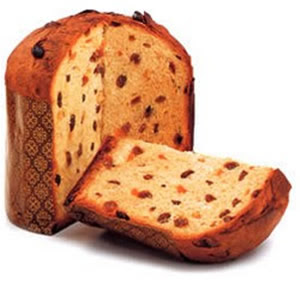 Panetón becomes its own food group during the month of December. The sweet bread with the little red and green candied dried fruit bits and raisins can be found everywhere. It is commonly given by employers to their employees to say thank you for your work during the year. It is also commonly given to friends to say Merry Christmas. Go to a church meeting or service over Christmas time and you'll more than likely come away eating panetón with its customary hot chocolate (I have had this experience at least 3 times in the past month, in addition to having 2 panetones in my house). It also makes a great breakfast or snack. Christmas in Cusco just isn't quite the same without panetón. So now your house is decorated and you've been enjoying your panetón and hot chocolate. What's next? Glad you asked.
If you live in my house, the next thing is celebrating Advent.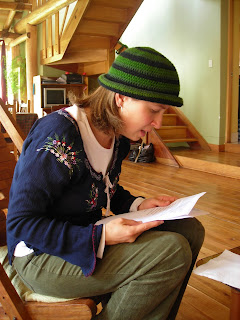 All throughout the month of December, my roommate and I celebrate Advent with our dear friend Marga,
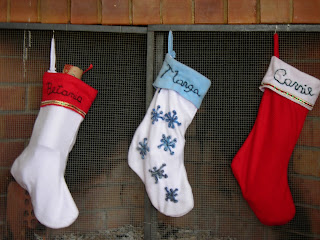
 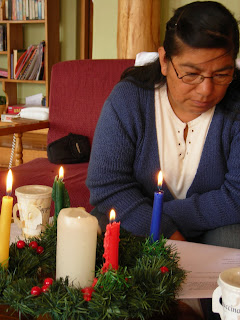 who helps us in our house, and anyone else who happens to be at our house on any given day. The lighting of the Advent candles give us a good way to remind us of the blessings that God has given us in the sending of His Son for us. Also, during this time, we hang our stockings and begin filling them with little gifts for each other. On December 23, the last day that Marga is with us
 before Christmas, we exchange the gifts in our stockings and finish the last day of Advent. It is a special time for all of us to be together and celebrate Jesus' birth and our friendship. This year, Carrie managed to find a place that sold cappuccinos to go (that is extremely rare in Cusco). Since we all love cappuccino, she brought some home as a special Christmas treat.
Christmas Eve morning dawns cool and cloudy, or rainy, possibly sunny if you're lucky. Despite the fact that we are technically in summer over this time, it's not hot. It's actually usually only in the 50s or 60s and generally cloudy or rainy. This, however, refuses to daunt the citizens of Cusco. Christmas Eve morning means the annual Santurantikuy (Quechua for "buy yourself a saint") market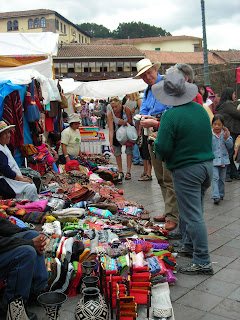 in the main plaza of the city.
  Here you can buy manger scenes, stables, plants to decorate your manger scene, baby Jesuses, handcrafts,
  little good luck charms for the new year, etc. This year I spent the morning at Santurantikuy with my good friend Lisi. W
 e had a lot of fun looking at the jewelry, finding a fun chullo for my roommate, deciding that we could make some notebooks like ones we saw for less than what they were selling for and have a lot more fun doing it, speaking Quechua to the vendors (that was me), and just seeing what there was to see. I saw a sign there that was both funny and sad. It said "We restore babies and saints". It sounds funny, but at the same time, it's sad.
  It represents the idolatry that is here in Cusco, of worshipping the Baby Jesus and the saints. It was a sad reminder that not all is as God would want it to be.
  Another interesting aspect of the Santurantikuy market is the good luck charms for the new year. You hope to buy a house next year? You can buy a little model of a house that's supposed to bring you good luck so you can buy a house. You want lots of money? Buy a packet of play money - soles, dollars or euros. You want to graduate from the university? You can even get a tiny little replica of a diploma to bring you good luck. You want work? You can buy a little replica of a hand holding a frog. (I have no idea why a frog. That's just the way it is).
 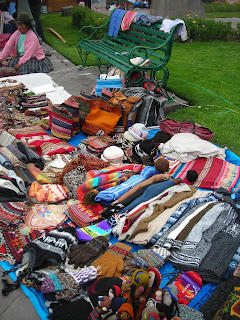 That will give you good luck so you can get a job. It's sad to see how people are so deceived into thinking that a little packet of play money or a model of a house can bring them good luck and provide what they want. I'd rather trust in the one who created the entire world and all that is within it, the one they call Jehovah Jireh. Nevertheless, Santurantikuy is an interesting experience.
Christmas Eve is when things really get interesting. In the evangelical church, churches often have Christmas Eve services, which include special numbers, food, fellowship and remembering the birth of Jesus. This year, after the church service, I went to be with my friend Mari, her brother Alfredo and her parents Roberto and Valeria. Christmas Eve is a traditionally family affair and I was blessed to be a part of their family that night. The Peruvian tradition is that everyone stays up till midnight (or later) on Christmas Eve. During the course of the evening sometime there is food (we had chicken, pork and potatoes) and people often play games, talk, watch movies, etc with their families. Around about 11:30 PM, you start to hear fireworks going off in the streets. At midnight, everyone goes out to the streets and the fireworks REALLY start to go off. All over the place, you can see little flashes of light sparkling in the night sky. In the midst of all this, everyone in your family gives each other a hug and wishes each other Feliz Navidad. Then you go back inside, exchange gifts and maybe play some more games and then go to bed.
Christmas day is actually kind of anticlimactic, as much of the celebration happens on Christmas Eve. Usually, it's spent with family eating and enjoying being together. Our EMM missionary team spent the day together eating, exchanging gifts and playing games (we have this thing for games on our team...strategy games, Dutch Blitz and Rook are some of our favorites). Then we all dispersed to go to our respective houses and call our respective families on skype to wish them a merry Christmas too.
Christmas in another country is always different. There's no "I'll be home for Christmas", no "I'm dreaming of a white Christmas". But God provides other blessings to make up for that. Being here in Cusco, away from my biological family, I've developed a deeper appreciation for the body of Christ. I may not have my parents, brothers, uncles, aunts, cousins and grandparents with me here, but God has given me family and made me a part of something larger than myself. So Feliz Navidad from me to you and may God bless you all in this new year, just as He continues to bless "all the dear children in [His] tender care".
 Santa Claus is well-known and decorations even sometimes include snow, despite the fact that it does not snow here in Cusco on Christmas...or any other time of the year, for that
  matter. Fortunately, however, the customs of Cusco still remain, despite the changing times. One custom that goes on throughout the entire month of December is the giving, receiving and consumption of fruitcake, called panetón.
  Panetón becomes its own food group during the month of December. The sweet bread with the little red and green candied dried fruit bits and raisins can be found everywhere. It is commonly given by employers to their employees to say thank you for your work during the year. It is also commonly given to friends to say Merry Christmas. Go to a church meeting or service over Christmas time and you'll more than likely come away eating panetón with its customary hot chocolate (I have had this experience at least 3 times in the past month, in addition to having 2 panetones in my house). It also makes a great breakfast or snack. Christmas in Cusco just isn't quite the same without panetón. So now your house is decorated and you've been enjoying your panetón and hot chocolate. What's next? Glad you asked.
If you live in my house, the next thing is celebrating Advent.
 All throughout the month of December, my roommate and I celebrate Advent with our dear friend Marga,
  who helps us in our house, and anyone else who happens to be at our house on any given day. The lighting of the Advent candles give us a good way to remind us of the blessings that God has given us in the sending of His Son for us. Also, during this time, we hang our stockings and begin filling them with little gifts for each other. On December 23, the last day that Marga is with us
 before Christmas, we exchange the gifts in our stockings and finish the last day of Advent. It is a special time for all of us to be together and celebrate Jesus' birth and our friendship. This year, Carrie managed to find a place that sold cappuccinos to go (that is extremely rare in Cusco). Since we all love cappuccino, she brought some home as a special Christmas treat.
Christmas Eve morning dawns cool and cloudy, or rainy, possibly sunny if you're lucky. Despite the fact that we are technically in summer over this time, it's not hot. It's actually usually only in the 50s or 60s and generally cloudy or rainy. This, however, refuses to daunt the citizens of Cusco. Christmas Eve morning means the annual Santurantikuy (Quechua for "buy yourself a saint") market
 in the main plaza of the city.
  Here you can buy manger scenes, stables, plants to decorate your manger scene, baby Jesuses, handcrafts,
  little good luck charms for the new year, etc. This year I spent the morning at Santurantikuy with my good friend Lisi. W
 e had a lot of fun looking at the jewelry, finding a fun chullo for my roommate, deciding that we could make some notebooks like ones we saw for less than what they were selling for and have a lot more fun doing it, speaking Quechua to the vendors (that was me), and just seeing what there was to see. I saw a sign there that was both funny and sad. It said "We restore babies and saints". It sounds funny, but at the same time, it's sad.
  It represents the idolatry that is here in Cusco, of worshipping the Baby Jesus and the saints. It was a sad reminder that not all is as God would want it to be.
  Another interesting aspect of the Santurantikuy market is the good luck charms for the new year. You hope to buy a house next year? You can buy a little model of a house that's supposed to bring you good luck so you can buy a house. You want lots of money? Buy a packet of play money - soles, dollars or euros. You want to graduate from the university? You can even get a tiny little replica of a diploma to bring you good luck. You want work? You can buy a little replica of a hand holding a frog. (I have no idea why a frog. That's just the way it is).
  That will give you good luck so you can get a job. It's sad to see how people are so deceived into thinking that a little packet of play money or a model of a house can bring them good luck and provide what they want. I'd rather trust in the one who created the entire world and all that is within it, the one they call Jehovah Jireh. Nevertheless, Santurantikuy is an interesting experience.
Christmas Eve is when things really get interesting. In the evangelical church, churches often have Christmas Eve services, which include special numbers, food, fellowship and remembering the birth of Jesus. This year, after the church service, I went to be with my friend Mari, her brother Alfredo and her parents Roberto and Valeria. Christmas Eve is a traditionally family affair and I was blessed to be a part of their family that night. The Peruvian tradition is that everyone stays up till midnight (or later) on Christmas Eve. During the course of the evening sometime there is food (we had chicken, pork and potatoes) and people often play games, talk, watch movies, etc with their families. Around about 11:30 PM, you start to hear fireworks going off in the streets. At midnight, everyone goes out to the streets and the fireworks REALLY start to go off. All over the place, you can see little flashes of light sparkling in the night sky. In the midst of all this, everyone in your family gives each other a hug and wishes each other Feliz Navidad. Then you go back inside, exchange gifts and maybe play some more games and then go to bed.
Christmas day is actually kind of anticlimactic, as much of the celebration happens on Christmas Eve. Usually, it's spent with family eating and enjoying being together. Our EMM missionary team spent the day together eating, exchanging gifts and playing games (we have this thing for games on our team...strategy games, Dutch Blitz and Rook are some of our favorites). Then we all dispersed to go to our respective houses and call our respective families on skype to wish them a merry Christmas too.
Christmas in another country is always different. There's no "I'll be home for Christmas", no "I'm dreaming of a white Christmas". But God provides other blessings to make up for that. Being here in Cusco, away from my biological family, I've developed a deeper appreciation for the body of Christ. I may not have my parents, brothers, uncles, aunts, cousins and grandparents with me here, but God has given me family and made me a part of something larger than myself. So Feliz Navidad from me to you and may God bless you all in this new year, just as He continues to bless "all the dear children in [His] tender care".
Monday, October 19, 2009
Demons Dancing in the Streets
 The last week in September marked the annual festival of San Jeronimo. San Jeronimo is the local patron saint of the area of Cusco where I live (also called, amazingly enough, San Jeronimo).
  In English, you may know him as Saint Jerome, who translated the Latin version of the Bible known as the Vulgate. San Jeronimo here is a large statue that dwells inside the
  church, comes out over Holy Week in March or April, returns a week later (accompanied by much dancing, food, and drinking), and is taken out of the church and paraded around again during the last week in September. Most schools in San Jeronimo have holidays over this time. Since PROMESA is not exactly into saint worship,
 we don't. But as we are in classes, we are hear strains of horn and drum music (typical fare for a saintly procession) floating across the air. For months before the actual event, leaving from the school in the
  afternoon, we see people practicing typical dances in the roofed concrete sport court close to the school. These people have to sign themselves up for these dances and pay for
  the
the  teacher to come teach them. There is one family in charge of each dance. Someone estimated that these families probably spend 3000-4000 soles each on this event. This is equal to roughly $1000-$1300 American money, which is quite a considerably larger percentage of one's resources here than in the States. Unfortunately, the use of this money on the festival of San Jeronimo usually means that the money is not used on things that it really should be, things such as improving one's house or taking care of one's children.
  The actual festival seems to be mostly an excuse for a lot of drunkenness.
  Alcoholism is a real stronghold here. The picture of the horn player with the beer bottle in his hand shows this well. Our friend Marga's husband Cesar has a barber shop right along the main street in San Jeronimo. During the week of celebration, one afternoon contains a parade which passes right by the front door of the barber shop. Marga invited my roommate Carrie and I to go with her and her family to
  watch the parades in front of the barber shop. For me, it was a very interesting afternoon full of questions and thoughts. I was surprised by the number of dances that involved demons (hence the title of this blog post). My thought was "If San Jeronimo is a saint (to the Catholics here) and people worship him as such, then why in the world would there be so many demon dances during a festival to honor him? What fellowship does light have with darkness?" In my way of thinking, it didn't make sense. I think it really hit me when the parade got stopped a little ways down from us. Two girls ran down the middle of the street to look at it. They came back yelling "Saqra! (Devil in Quechua)" with the chill of thrilling terror that ghost stories around a camp fire often give children. Even some of the dances contained "Saqra" in the name. My friend Lisi gave me an explanation for this phenomenon that I really liked and which really made sense to me. She said, "If San Jeronimo is a demon (from an evangelical point of view, since he is worshipped as an idol), then it makes sense that other demons would be around him and be a part
  of the celebration." Simple. True. Another interesting fact that Marga shared with us later, while reflecting on the dances, is that they are changing as the world changes.
  Skirt hems move from knees to thighs to upper thighs. More dances involve demons and ugly masks. Fewer are innocent and beautiful. There are more dances. It was interesting to note this bit of information. All in all, it was an interesting, afternoon of dances, music, food and lots of color. It made me realize again just how lost those of the world are, those who carry around their unmoving gods on their shoulders, dancing as demons for demons.
Thursday, October 15, 2009
Unsung Heroes
There are many unsung heroes here in Cusco, people who often work unrecognized or under-appreciated. Yet, without them, our lives would be much different and much more unpleasant. Today, though they'll never read this, I'm sure, I'd like to dedicate this post to some of them:
To the bus, combi and taxi drivers - If you've never been here, Cusco driving is....well, let's say different....than United States driving. (If you don't believe me, ask my parents). Drivers here have to be a lot more alert and agressive. Horns are just as necessary (if not more so) than brakes. Swerving in and out of traffic is so normal that I don't even think about it. My parents were on the edge of their seats many times during their times here, while I am so used to this driving style that I read books through it while going to town (and love doing so). Not having my own car, I rely almost exclusively on public transportation. Though car accidents are not unknown, I have been safe throughout the year and 9 months I've been here. I realized the other week that I owe my road safety up to this point to God and to the good driving of all the many bus, combi and taxi drivers in whose cars I have ridden. Thank you!
Public sanitation department - Litter. It's a big problem here. Big. There is litter on the streets all the time. The custom here is eat it and toss it, no matter where you are. Though people are becoming more aware of litter and lack thereof, it's going to be a LOOONG process to change a society's ways. But in the midst of the litter problem, there is the public sanitation department. These courageous men and women walk the streets with their face masks, brooms and trash bags, cleaning up after the rest of society. Or they ride on the back of the trash truck, listening the warbling music flowing from the speakers mounted on top, grabbing people's trash bags. Or they ring a triangle in front of the trash truck so that people will remember it's time to put out their trash (it really is a nice reminder). The other week was the parade for the local saint, San Jeronimo. The main street of San Jeronimo was, well, to put it nicely, not the cleanest afterwards. The next morning I observed on the way to school that the remnants of the parade had all been swept away and the street looked presentable again. Another morning I was walking to school from the bus stop and saw piles of trash in the middle of the street. Walking further, I saw someone sweeping them up. Of course, with four schools on our one street, it didn't last long, but it looked nice while it did last.
Maids - They are generally looked down upon and not respected (I'm trying to change that, at least in our case). They go to someone else's house, cook and clean for them , run errands and generally do whatever else that person doesn't have time to do. (Some very important things are only open while we are at school....like customs at the post office and the telephone company). Then they go back to their own homes and do the same thing. Usually, they work for peanuts, even by Peruvian standards. But their work is such a blessing. In our case, since we don't have a mom or a husband to cook for us, don't eat lunch at school and Crock-Pots are an unknown invention here, having someone to cook lunch, the main meal of the day, is a necessity and a blessing. And spending a great deal of time working on school stuff in the afternoons and evenings makes not having to clean a blessing. Marga, our maid, is one of my best friends here and a true sister in Christ. I saw a sign on vacation in Arequipa that summed it up perfectly: Not even the king would eat if the worker did not work".
There are many more, but these are the ones that stuck out to me while thinking about it lately. So here's to the unsung heroes in our lives and thank you for all you do!
To the bus, combi and taxi drivers - If you've never been here, Cusco driving is....well, let's say different....than United States driving. (If you don't believe me, ask my parents). Drivers here have to be a lot more alert and agressive. Horns are just as necessary (if not more so) than brakes. Swerving in and out of traffic is so normal that I don't even think about it. My parents were on the edge of their seats many times during their times here, while I am so used to this driving style that I read books through it while going to town (and love doing so). Not having my own car, I rely almost exclusively on public transportation. Though car accidents are not unknown, I have been safe throughout the year and 9 months I've been here. I realized the other week that I owe my road safety up to this point to God and to the good driving of all the many bus, combi and taxi drivers in whose cars I have ridden. Thank you!
Public sanitation department - Litter. It's a big problem here. Big. There is litter on the streets all the time. The custom here is eat it and toss it, no matter where you are. Though people are becoming more aware of litter and lack thereof, it's going to be a LOOONG process to change a society's ways. But in the midst of the litter problem, there is the public sanitation department. These courageous men and women walk the streets with their face masks, brooms and trash bags, cleaning up after the rest of society. Or they ride on the back of the trash truck, listening the warbling music flowing from the speakers mounted on top, grabbing people's trash bags. Or they ring a triangle in front of the trash truck so that people will remember it's time to put out their trash (it really is a nice reminder). The other week was the parade for the local saint, San Jeronimo. The main street of San Jeronimo was, well, to put it nicely, not the cleanest afterwards. The next morning I observed on the way to school that the remnants of the parade had all been swept away and the street looked presentable again. Another morning I was walking to school from the bus stop and saw piles of trash in the middle of the street. Walking further, I saw someone sweeping them up. Of course, with four schools on our one street, it didn't last long, but it looked nice while it did last.
Maids - They are generally looked down upon and not respected (I'm trying to change that, at least in our case). They go to someone else's house, cook and clean for them , run errands and generally do whatever else that person doesn't have time to do. (Some very important things are only open while we are at school....like customs at the post office and the telephone company). Then they go back to their own homes and do the same thing. Usually, they work for peanuts, even by Peruvian standards. But their work is such a blessing. In our case, since we don't have a mom or a husband to cook for us, don't eat lunch at school and Crock-Pots are an unknown invention here, having someone to cook lunch, the main meal of the day, is a necessity and a blessing. And spending a great deal of time working on school stuff in the afternoons and evenings makes not having to clean a blessing. Marga, our maid, is one of my best friends here and a true sister in Christ. I saw a sign on vacation in Arequipa that summed it up perfectly: Not even the king would eat if the worker did not work".
There are many more, but these are the ones that stuck out to me while thinking about it lately. So here's to the unsung heroes in our lives and thank you for all you do!
Thursday, October 1, 2009
What Would Jesus Do....one step further
The other week I was disturbed out of my devotional time at 7:15 on a Saturday morning by the doorbell being rung insistently. Till it w as all said and done, the man next door is working on his house and was convinced that a small room beside our front door, not connected directly to the house, was going to fall down should he begin digging around its foundations. We later learned he may have had a point, but the insistency with which he was saying that the room should come down and the urgency of it happening in order for their apartment building to be raised next door did not sit well with me at that point. I must confess that I did not exactly treat them like Jesus probably would have. It made me think, though. I began to wonder what it would be like to know exactly what Jesus would have done in every situation. I began to think how nice it would have been if the Bible contained the complete record of everything Jesus said and did in every situation.
And then I began to think of the ramifications that would bring. And God began to speak to my heart of the ramifications that it would bring. Imagine with me, if you will, that the entire life of Jesus was chronicled in the Bible....everything He said and did, every situation in which He found Himself. Imagine yourself as a God follower in this situation. You have your Bible. And then you have a massive book that chronicles where to find any incident in Jesus' life. Someone stole your wallet while walking downtown? Look up stolen belongings in your reference book. Gospel of Peter 4:17. You flip open to the Gospel of Peter and look up what Jesus did in that situation. And then you "go ye and do ye likewise". It would make "What Would Jesus Do?" a whole lot simpler, wouldn't it?
And then God showed me the horrid reality that that would really bring. If all I had to do was know where to look in the Bible and then follow what it said in that passage, that cuts off relationship right there! Why do I need to know God's heart and search to know Him more, if all I have to do is know where to find the correct answers about Him? Knowing where to find answers of how to live correctly in any situation in the Bible means God becomes a formula. If A, then B. If B, then C. And then who would really care about God as God anymore? Christianity would become just another religion, people trying to get to heaven by doing everything right.
And then God showed me something freeing and beautiful. He cares so much more about having a relationship with us than about us getting everything right. He created us with free will so that we can choose what we're going to do, whether it's what is right or what is not right. Yeah, we're going to make some wrong choices, but the relationship is still there. And then He provided us grace so that when we do choose what is not right, we can still have that relationship with Him. It's so simple, so complex, and so beautiful.
So I can ask myself "What would Jesus do?", but the answer might not be found in red ink in my Bible. The answer just might be found in seeking His heart and in wanting to know Him better. The answer just might be found in being in relation with Him. And I think that's a pretty good place for it to be hiding.
And then I began to think of the ramifications that would bring. And God began to speak to my heart of the ramifications that it would bring. Imagine with me, if you will, that the entire life of Jesus was chronicled in the Bible....everything He said and did, every situation in which He found Himself. Imagine yourself as a God follower in this situation. You have your Bible. And then you have a massive book that chronicles where to find any incident in Jesus' life. Someone stole your wallet while walking downtown? Look up stolen belongings in your reference book. Gospel of Peter 4:17. You flip open to the Gospel of Peter and look up what Jesus did in that situation. And then you "go ye and do ye likewise". It would make "What Would Jesus Do?" a whole lot simpler, wouldn't it?
And then God showed me the horrid reality that that would really bring. If all I had to do was know where to look in the Bible and then follow what it said in that passage, that cuts off relationship right there! Why do I need to know God's heart and search to know Him more, if all I have to do is know where to find the correct answers about Him? Knowing where to find answers of how to live correctly in any situation in the Bible means God becomes a formula. If A, then B. If B, then C. And then who would really care about God as God anymore? Christianity would become just another religion, people trying to get to heaven by doing everything right.
And then God showed me something freeing and beautiful. He cares so much more about having a relationship with us than about us getting everything right. He created us with free will so that we can choose what we're going to do, whether it's what is right or what is not right. Yeah, we're going to make some wrong choices, but the relationship is still there. And then He provided us grace so that when we do choose what is not right, we can still have that relationship with Him. It's so simple, so complex, and so beautiful.
So I can ask myself "What would Jesus do?", but the answer might not be found in red ink in my Bible. The answer just might be found in seeking His heart and in wanting to know Him better. The answer just might be found in being in relation with Him. And I think that's a pretty good place for it to be hiding.
Subscribe to:
Posts (Atom)